Get our FREE 30-Minute Weeknight Recipes E-book!Grab it
Back to all posts
Recipes

Fluffy Buttermilk Pancakes for Slow Mornings

Rest the batter for ten minutes. That is the entire secret — the flour hydrates, the bubbles settle, and the pancakes rise tall on the griddle.

Fluffy Buttermilk Pancakes for Slow Mornings

Prep time

10 min

Cook time

15 min

Serves

12 pancakes

Ingredients

Step-by-Step Instructions

Follow along photo by photo — every stage below shows exactly what to look for before you move on.

  1. Dry ingredients being measured on a kitchen counter
    Step 13 minutes

    Whisk the dry ingredients thoroughly

    Whisk the flour, sugar, baking powder, bicarbonate of soda and salt together in a wide bowl for a good twenty seconds. This is effectively sifting: it breaks up any clumps of raising agent so you never get a bitter, soapy pocket in a finished pancake.

    Make a shallow well in the centre. It gives the wet mixture somewhere to sit so you can fold from the outside in, which takes far fewer strokes than chasing batter around a flat surface.

  2. Pancake batter being whisked in a ceramic bowl
    Step 24 minutes

    Combine the wet mixture and fold gently

    Beat the buttermilk, eggs and melted butter together until uniform, then pour into the well and fold with a spatula just until no dry flour remains. Ten or twelve strokes is usually enough.

    The batter should look lumpy and slightly shaggy — that is exactly right. Every extra stir develops gluten, and gluten is what turns a tender pancake into a rubbery one. Resist the urge to smooth it out.

    Tip · No buttermilk? Stir a tablespoon of lemon juice into 400ml of milk and leave it for ten minutes.

  3. Batter resting in a bowl beside a warming pan
    Step 310 minutes

    Rest the batter while the pan heats

    Leave the batter alone for ten minutes. The flour hydrates fully, the lumps dissolve on their own, and the raising agents begin producing the bubbles that give you height on the griddle.

    Meanwhile, set your pan over medium-low heat — lower than instinct suggests. A flick of water should skitter and evaporate within a couple of seconds; if it vanishes instantly the pan is too hot and the outsides will scorch before the centres set.

  4. Pancakes cooking on a griddle with a spatula
    Step 412 minutes

    Cook until the bubbles set at the edges

    Brush the pan with butter and drop in quarter-cup scoops, leaving space between them. Wait until bubbles rise, break, and stay open at the edges — a hole that closes back over means the batter underneath is still wet.

    Flip once, confidently, and cook for barely a minute more. Every additional flip presses out the air you worked to build, so one turn per pancake is the rule.

    Tip · Wipe the pan with kitchen paper between batches; browned butter solids will speckle the next round.

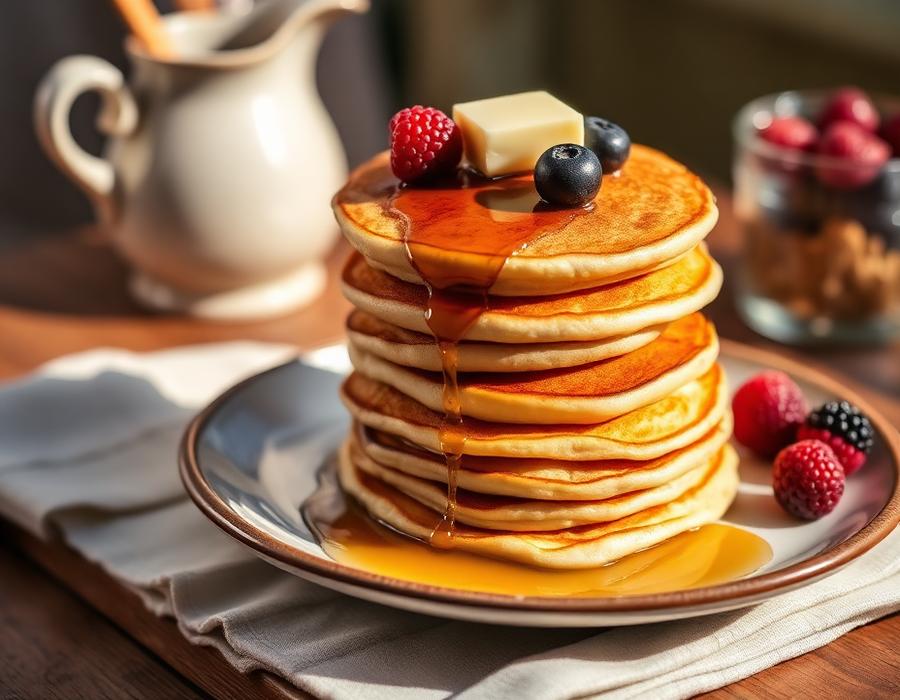
  5. Finished stack being served at the table
    Step 52 minutes

    Stack, butter, and serve while hot

    Stack as you go, sliding a knob of butter between every other layer so it melts down through the pile rather than sitting on top.

    Pour the syrup at the table while everything is still steaming. If you are cooking for a crowd, hold the finished pancakes in a single layer on a rack in a 90°C oven — stacking them on a plate traps steam and softens the edges.